Lowlander
Long and varied as the histories of the known world and its people are, there is a surprising lack of knowledge as to the true origins of humanity. Absent in the days of the ancient dwarven empires, fleeting when the monoliths raised the orcish tribes into dominance, humans seemed to have simply risen from the earth and took root in the places in between greater peoples. Early dwarven accounts described them as “children grown far too tall,” for while they lacked much of the knowledge of the First People, they were full of wonder and a zeal for learning what they could. Clever and devastatingly shrewd on matters of commerce and diplomacy, it was not long before humanity spread like wildfire (or weeds if one were feeling less than charitable) to all corners of the known world.
It is said that there is no great nation that stands without a human at its heart. While this may be true of most of the great nations, it is also true that many of those very same nations were not always of human origin, and that through political and cultural arm-wrestling humans assimilated the very nations they were meant to assimilate into themselves. This adaptability has long since been considered their greatest strength though it often comes at odds with others around them.
The Rise of the Light
Human history has been marked by recurring wars and conflicts primarily among themselves. While few details and accounts remain of the conflict that drove the descendants of what would now be known as lowlanders down from the mountain, it seemed to begin with something divine. The spirits of old no longer held the same glory as the spirit of Light, and in its glow, humans found new guidance. Their spiritual lives stopped circling around appeasing and stepping around the often fickle and unfathomable will of the elements and instead turned inward and introspective, becoming more a question of how mankind can best help and serve one another over how mankind might appease wrathful spirits.
The most faithful of the time might have said it was divine inspiration that their society also was beginning to turn away from the nomadic traditions of their ancestors. They raised villages that would become cities, and in those cities they were able to build up societies so intrinsically human that they almost defy belief. Just as they believed in the Light, they too believed in the institutions of law and structure, so much so that nearly every facet of their society was built with certain stratification in mind. Humans divided themselves by wealth, by profession, even divided themselves between those ruled and those who rule. Humans are arguably far from the strongest and most capable combatants in the realm but even their military is structured and varied to intuit and then counter what forces might clash with them to devastating effect.
Bastions of Culture
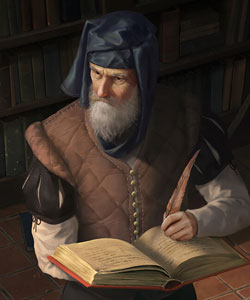
Literacy is highly valued but not entirely accessable.
Just as sedentary life allowed humans to flourish and expand their mighty cities, it has also afforded them a rich and influential culture. There are few things taboo among humans, including magic, which is becoming more and more celebrated as a form of academia rather than evil-natured sorcery. While it may still be considered bad manners to speak too openly of magic, its study is nevertheless more accessible to those with the means to reach out to the circles and academies.
Theater, music, and artwork are coveted as high cultured pastimes. Many of the greatest plays of poems the era were penned by human hands, and playhouses are common in or around squares and plazas where nobility tend to take their leisure. The ideal of the “artiste” is one highly coveted though it can be a difficult road to success. The struggle itself is so romanticized that in larger cities, starving artists make up a significant portion of the impoverished. In a society where economic mobility is made all the more difficult, a single lucky break in finding a wealthy patron can mean the start of a long and glorious career: be it in the arts, in academia, or even in politics.
The Knighthood and its Influence
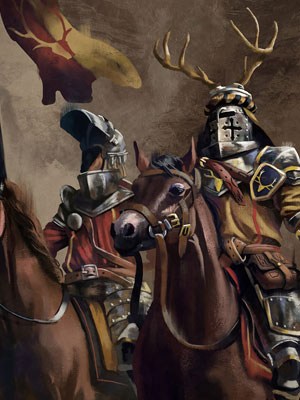
Knights representing noble houses are often called to joust for their honor.
Apart from being important as elite units in human military regiments, knights also represent the one of the highest aspirations anyone in the realm can achieve. Traditionally, knights serve as an extension of the noble houses to which they are bound, with the highest honors being given to those in service of royal families. Jousting, a popular sport, is where one might see a great many knights adorned in banners and barding of all manner of color and sporting the crests of important families. In times of peace, knights may also be elected to positions within the local guard, typically in places of leadership. Many move on to places of political power, made all the more easy by having their to speak to their honor. To become a knight is to earn a life of prestige and a place of high praise in the hearts of the people.
It has also been long standing tradition that knighthood be reserved for humans - more specifically, humans of noble birth themselves. However, this has been a tradition that has seen more and more exception over recent generations all across the realm. Those who embody noble intentions and can fight with honor and grace can petition for knighthood, or at least a lesser form of it. These so-called hedge knights are rarely granted the full suite of status that traditional knights enjoy: no land, no official title, and very little by way of wealth or influence. While it remains an honorable calling, their options are typically limited to glorified guards or, in times of war, front-line soldiers to bolster the ranks.
Racial Relations
- With High Elves: Excellent. Despite somewhat rocky beginnings, High Elves have easily adapted themselves into human lifestyles and have brought plenty of their own ways to the table. Most fascinating is their understanding of the Arcane, but arguably the structures of Elven noble houses have had heavy influence on human nobility as well.
- With Wood Elves: Fair. They are decidedly less civilized than their High Elven kin but they certainly have their place in the world. There are none more keen with Druidic magic, and they easily fall into caring for the farms and ranches that feed the cities.
- With Dark Elves: Dubious. While it’s true that much of what humanity was taught to believe of them might be exaggeration, there still seems to be plenty that is not. Their proclivity towards thievery, for example - disgraceful!
- With Dwarves: Wonderful! Incredible artisans, scholars, and teachers, there is much that the partnership with Dwarvenkind has brought to better humanity as a whole.
- With Orcs: Uncomfortable. Humans have warred with orcs nearly as long as they’ve warred with themselves. There’s a fundamental difference in lifestyle that makes mutual understanding difficult - though not for lack of trying in places like Aetheral.
- With Humans: Fair. There will always be conflict amongst themselves, but they will always find ways to mend and heal. Adaptability is humanity’s greatest trait and there is none that know it better than other humans.